
Operational Status: Thermodynamic 40–60°C Self-Activation Set | Metal-Free Anodic Matrix Latched | Crystalline Matrix Anchoring Complete | CO Catalyst Poisoning Immunity Locked
Two Advanced Chemistries. One Secure Future.

NuCell Corporation Introduces
Two Zero-Failure Technologies
Safe, Low-Cost Solid-State Grid Storage Batteries
&
Multi-Temperature Anhydrous Fuel Cells
Fuel Cell Freedom Across Every Thermal Window.
The Safest Path to Unlimited Grid Storage.
Powered by non-flammable, completely metal-free Lithium-Sulfide (Li₂S) and Sodium-Sulfide (Na₂S) solid-state platforms, NuCell Corporation engineers the foundation for abundant, long-duration energy storage (LDES) across tomorrow's utility-scale grid infrastructure—eliminating dendrite failures entirely.
Operating natively from 25°C to 180°C, NuCell Corporation’s engineered crystalline matrix membranes drive highly scalable 1 kW to 10 kW series stacks. By completely suppressing fuel crossover and catalyst poisoning, we enable next-generation aerospace and drone propulsion systems to run seamlessly on raw, unrefined hydrogen.
NUCELL TECHNOLOGY PLATFORM:
METAL-FREE SOLID-STATE LITHIUM-SULFIDE STORAGE
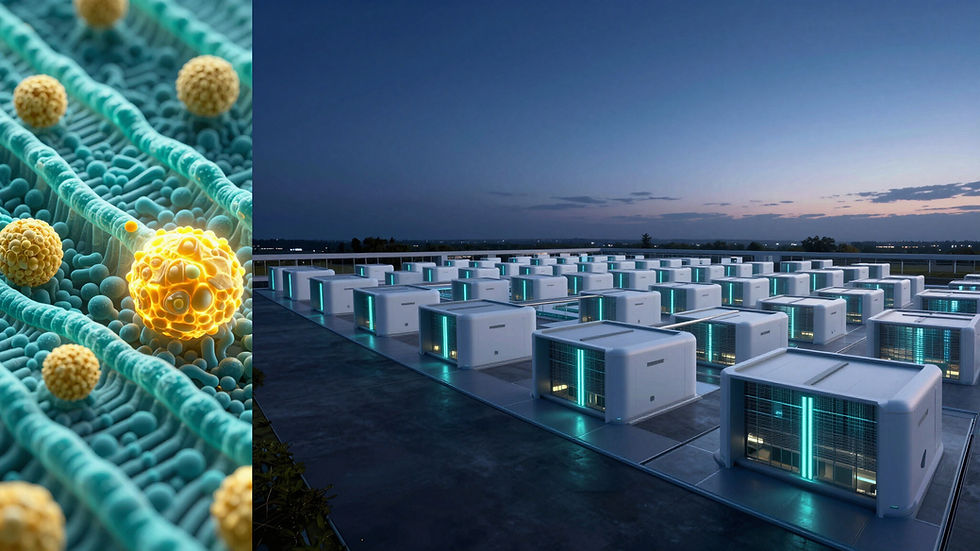
Core System Architecture
Catalytic Cathode Engine
NuCell utilizes a template-directed, hierarchically organized catalytic carbon-nanotube network. By minimizing inactive carbon weight to an absolute baseline electronic spine, we eliminate dead mass and maximize active material loading. A high-density distribution of ultra-fine 10 nm electrocatalytic nanodots is anchored uniformly across this carbon spine, acting as localized, highly active reaction centers. These sub-micron nodes chemically immobilize active sulfur species and accelerate conversion kinetics in situ, completely preventing phase drop-out and polysulfide dissolution across thousands of long-duration cycles.
Asymmetric Janus QSPE
Flammability risks are eliminated through our bi-layer, direct-on-electrode asymmetric Quasi-Solid-State Electrolyte. This architecture molecularly cages non-volatile liquid domains within open sub-nanometer channels. The crystalline nodes permanently anchor anions, neutralizing localized space-charge layers that historically drive dendrite short-circuits, guaranteeing safe, multi-hour utility deployment across extreme operational lifecycles
Disrupting the Stationary Energy Storage Matrix
Modern electrical grids are bottlenecked by legacy lithium-ion and lithium iron phosphate chemistries that are approaching their physical limits and require heavy HVAC cooling to prevent dangerous thermal runaway.
NuCell Corporation completely resolves these interlinked failure modes through an engineered Dual-Phase Structural Confinement approach using an advanced pre-lithiated Lithium-Sulfide (Li2S) configuration. Operating natively within a self-activating 40–60°C thermodynamic window, our solid-state platform utilizes natural operational heat as a kinetic asset to maximize round-trip grid efficiency while completely eliminating the safety risks associated with metallic lithium anodes.

Intrinsic Safety
Non-flammable solid-state platform for critical grid assets. Bi-layer asymmetric Quasi-Solid-State Electrolytes completely eliminate flammability risks and dendrite short-circuits by caging non-volatile liquid domains within open sub-nanometer channels. This structural barrier anchors internal ions, maintaining a stable, non-reactive interface that guarantees safe utility deployment without the risk of localized shorting.

Thermal Efficiency
Operates naturally in the 40–60°C window without heavy cooling. NuCell's solid-state architecture uses natural operational heat as a kinetic asset rather than a liability. By operating natively within a self-activating 40–60°C thermodynamic envelope, the platform accelerates conversion kinetics and maximizes round-trip grid efficiency—entirely eliminating the need for complex, energy-intensive HVAC cooling systems.

Grid-Scale Density
Engineered for long-duration storage across utility-scale deployments. Template-directed, hierarchically organized carbon-nanotube networks maximize active Lithium-Sulfide (Li2S) material loading while stripping away dead weight. Enhanced by high-density arrays of ultra-fine 10 nm electrocatalytic nanodots, this core engine accelerates material conversion in situ to deliver reliable, long-duration energy storage (LDES) across thousands of continuous cycles.
NUCELL TECHNOLOGY PLATFORM:
EARTH-ABUNDANT SOLID-STATE SODIUM-SULFIDE STORAGE
Breaking the Critical Mineral Bottleneck
Utility-scale grid infrastructure requires an energy storage platform free from geopolitical supply-chain vulnerabilities, volatile commodity pricing, and rare-earth dependence.
NuCell Corporation delivers absolute resource independence through a solid-state Sodium-Sulfide (Na2S) platform built entirely on cheap, globally abundant, and non-toxic materials. By operating natively within our localized 40–60°C thermodynamic envelope, the system utilizes its own kinetic energy to accelerate slow sodium-ion transport dynamics, matching the performance profiles of premium chemistries at a fraction of the raw capital cost.
Intrinsic Safety
Non-flammable solid-state platform for critical grid assets. Bi-layer asymmetric Quasi-Solid-State Electrolytes completely eliminate flammability risks and dendrite short-circuits by caging non-volatile liquid domains within open sub-nanometer channels. This structural barrier anchors internal ions, maintaining a stable, non-reactive interface that guarantees safe utility deployment without the risk of localized shorting.
Thermal Efficiency
Operates naturally in the 40–60°C window without heavy cooling. NuCell's solid-state architecture uses natural operational heat as a kinetic asset rather than a liability. By operating natively within a self-activating 40–60°C thermodynamic envelope, the platform accelerates conversion kinetics and maximizes round-trip grid efficiency—entirely eliminating the need for complex, energy-intensive HVAC cooling systems.
Grid-Scale Density
Engineered for long-duration storage across utility-scale deployments. Template-directed, hierarchically organized carbon-nanotube networks maximize active Sodium-Sulfide (Na2S) material loading while stripping away dead weight. Enhanced by high-density arrays of ultra-fine 10 nm electrocatalytic nanodots, this core engine accelerates material conversion in situ to deliver reliable, long-duration energy storage (LDES) across thousands of continuous cycles.
Core System Architecture
High-Capacity Sulfide Conversion Core
Our architecture bypasses traditional intercalation mechanisms by utilizing a fully specialized, pre-loaded sodium-sulfide (Na2S) active core. This multi-phase conversion engine is locked inside a highly conductive, porous microscopic matrix that accommodates the volumetric expansion of sodium ions during cycling. The localized framework provides continuous electronic pathways, forcing the high-capacity sulfide chemistry to achieve near-theoretical energy densities without internal material degradation.
Non-Reactive Sodium-Ion Solid Electrolyte
To prevent the formation of reactive sodium paths and eliminate fire hazards, NuCell deploys a specialized, anion-anchoring asymmetric Quasi-Solid-State Electrolyte. This solid structural barrier isolates the chemical phases while permitting rapid, low-resistance sodium-ion mobility through predefined sub-nanometer channels. The result is a rock-solid, non-volatile interface that delivers decades of maintenance-free, long-duration energy storage (LDES) for the modern power grid.

NUCELL TECHNOLOGY PLATFORM:
ANHYDROUS FUEL CELL MEMBRANES

Core Membrane Architecture
Water-Mimicking Crystalline Matrix
NuCell utilizes a highly stable, post-synthetically modified crystalline host matrix possessing open sub-nanometer channels. Through a targeted liquid-phase processing workflow, flexible, non-volatile organic dipoles are permanently grafted onto the framework nodes. These chains act as permanent water-mimicking dipoles, stabilizing acid protons and facilitating rapid Grotthuss proton-hopping completely independent of external relative humidity or aggressive high-altitude ambient conditions.
Engineered Tri-Layer Protective Interface
The functional crystals are blended into a thermally robust structural polymer host, providing supreme mechanical modulus up to 180°C to withstand rigorous physical stack compression pressures. To ensure absolute electrochemical robustness at the boundaries, the composite core is thin-coated on each electrode interface with a sub-micron perfluorinated protective skin. This matrix insulates the internal crystalline framework from direct catalytic reduction while maintaining seamless, high-velocity interfacial proton relay into the surrounding gas flow-field channels.

Water-Independent Mobility
Zero-humidity proton transport kinetics. An engineered crystalline matrix permanently anchors conductive counter-anions within sub-nanometer channels, enabling rapid Grotthuss proton-hopping. This allows the fuel cell propulsion systems to maintain peak efficiency completely independent of external relative humidity or atmospheric moisture levels.

Eliminates traditional liquid-water dehydration bottlenecks. By operating natively across an extended thermal window up to 180°C, NuCell's platform prevents power drops and localized material degradation. This wide operational capability eliminates the need for bulky, heavy thermal management radiators, maximizing the payload capacity of unmanned aircraft systems (UAS).
180°C Thermal Envelope

Scalable Series Architecture
Driving high-fidelity 1 kW to 10 kW aviation power plants. Sub-micron perfluorinated protective skins insulate the inner framework cores, delivering supreme mechanical durability under uniform structural clamping force. This robust interface allows individual cells to be compressed reliably into high-density 1 kW base stacks up to 10 kW modular propulsion clusters.
Unleashing Multi-Temperature Energy Conversion
Traditional proton exchange membranes (PEMs) restrict clean-tech deployment because they rely on fluid liquid-water networks, causing severe power drops and material degradation above 80°C due to dehydration.
NuCell Corporation completely circumvents this thermal bottleneck through an engineered, water-independent hybrid composite membrane. By engineering a stable, earth-abundant crystalline matrix that permanently anchors conductive counter-anions inside open sub-nanometer channels, NuCell establishes a zero-humidity, multi-temperature conversion platform. This framework drives highly scalable 1 kW to 10 kW series fuel cell stacks, tailored specifically for deep decarbonization across heavy transport, drone propulsion, and rugged aerospace infrastructure
Deep Scientific Leadership

Braja Mandal, PhD — Founder & Chief Technology Officer
Dr. Braja Mandal is the Founder, President, and CEO of NuCell Corporation, serving as an Emeritus Professor of Chemistry at the Illinois Institute of Technology (IIT) and a Guest Researcher at Argonne National Laboratory (ANL). With over 35 years of tenure in advanced materials chemistry, Dr. Mandal is an internationally recognized expert in solid polymer matrices, functional ion-conducting electrolytes, and advanced electrochemical storage mechanics.
At NuCell, he commands the company's core intellectual property portfolio, directing the pilot-scale synthesis of advanced anhydrous crystalline host frameworks and the structural optimization parameters of our scalable, modular power plant architectures.
Technical Pillars & Strategic Benchmarks
-
Executive Authorship: Author of the definitive graduate-level textbook, Polymer Synthesis: Strategies and Tactics, establishing foundational material design concepts used globally in advanced macromolecular research.
-
Published Contributions: Authored 107 peer-reviewed research articles in top-tier international scientific journals spanning polymer science, energy storage, and advanced transport materials.
-
Grant Performance: Successfully secured and executed 23 high-value research grants from premier federal agencies and industrial clean-tech funding institutions.
-
Academic Supervision: Directed and supervised 24 successful Ph.D. and M.S. materials science theses, successfully translating fundamental molecular theory into validated, high-performance physical materials.
-
Distinguished Fellowships: Awarded the prestigious Alexander von Humboldt Postdoctoral Fellowship in Germany and named an Indian National Merit Scholar.
Contact NuCell Corporation
Corporate Headquarters & Wet Lab Facility
NuCell Corporation
University Technology Park (UTP)
3440 South Dearborn Street, Suite 138S
Chicago, Illinois 60616
Principal Investigator Communication Lines:
Phone: 630-291-3414
Direct Corporate Email: mandal@nucellcorp.com
Corporate Digital Platform: www.nucellcorp.com